Published on August 20, 2025
Zinda Products: A Tradition From Elsewhere Brought Here
In Québec, we can be proud of many things: our language, our landscapes, our products. Among all these sources of pride, it’s important to highlight the remarkable work of our entrepreneurs. That’s why today, we want to shine a light on the work of one of our many local businesses.
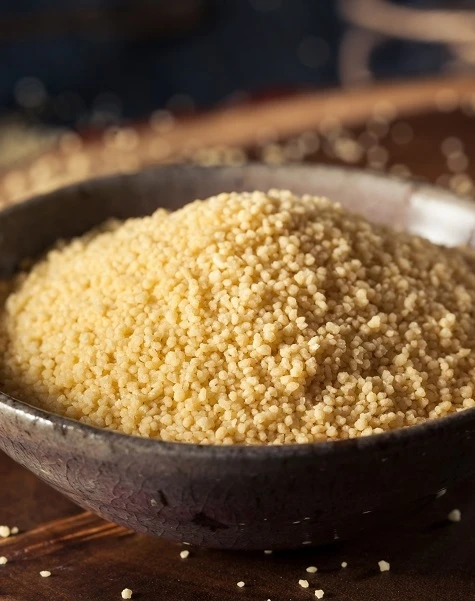
Who would have thought that Québec-made couscous could rival its North African counterpart? All of this became possible thanks to none other than Produits Zinda. This family-owned company settled on Montreal’s South Shore, in Candiac, 24 years ago. Today, Zinda proudly stands as one of the world’s largest Canadian couscous producers. In fact, Zinda exports its Québec-made couscous internationally—no small accomplishment!
Heart and Appetite
The Zinda project was born from the fusion of the best grain—Canadian wheat—and the heritage of ancestral know-how passed down from generation to generation. Founded in 1999 by Mr. Majid Jamal Eddine, Zinda Products has evolved over the past 20 years with a single goal in mind:
“To produce in Canada a high-quality couscous made from Canadian durum wheat semolina.”
Today, the Québec-based company employs more than fifty people at its Liberté Avenue site in Candiac. With a 36,000-square-foot plant located on nearly one hectare of land, it’s clear that Zinda doesn’t do things halfway! Each year, they have the capacity to produce 15,000 tonnes of Couscous, Pearl Couscous, and Orzo within an 8,500-square-foot production area. Even if all these huge numbers seem abstract, trust us—it's a lot of couscous!
Unique Process
Contrary to what some might believe, couscous doesn’t grow that way (no judgment if you thought it did)! First, it’s important to understand that semolina is the base ingredient of couscous. Fun fact: the semolina used by Zinda Products comes entirely from the Canadian Prairies. Once delivered, the semolina is transformed into various types of couscous such as natural, organic, and whole wheat.
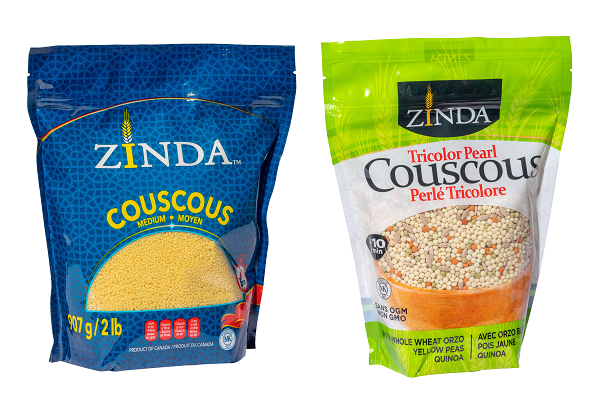
That said, how does semolina turn into those delicious little granules? When the semolina enters the plant, it is hydrated and mixed so that the particles stick together and form small pellets that will then be cooked at a high temperature. After this high-heat cooking, the tiny pellets are separated, dried, cooled, and then sifted. Once all these steps are completed, the couscous is ready to be packaged and shipped across the country and abroad.
In short, we can now add to our list of sources of pride the fact that Québec know-how can create the best of the best! To learn more about the history of Zinda Products and their varieties of couscous, we invite you to visit produitszinda.ca.